
Quick Answer: When weighing room addition vs ADU Palo Alto options, a room addition typically costs $150,000–$350,000 and adds livable space that appraisers value directly, while an ADU costs $250,000–$500,000 but can generate $3,000–$5,500 monthly rent. Choose an addition for family space and resale value on smaller lots; choose an ADU if you want rental income or multi-generational flexibility.
Deciding between a room addition and an ADU in Palo Alto usually comes down to one question: do you need the space, or do you need the income? A room addition adds finished square footage to your existing home for roughly $150,000–$350,000, while a detached ADU runs $250,000–$500,000 but can produce rental income of $3,000–$5,500 a month depending on the neighborhood. Palo Alto’s tight R-1 setback rules and lot sizes under 6,000 sq ft in many neighborhoods make this decision more complicated than it looks on paper. This guide walks through cost, resale value, zoning, and rental comps so you can pick the right project for your lot, then points you to our full breakdown if a room addition turns out to be the better fit.
Get a free estimate from a licensed Palo Alto contractor before you commit to either path. Small differences in lot shape and setback exposure can swing your project cost by tens of thousands of dollars.
Room Addition vs. ADU in Palo Alto: What’s the Real Difference?
A room addition extends your existing house, attaching new square footage to your current structure. An ADU (accessory dwelling unit) is a separate, independently livable unit, either attached or detached, with its own kitchen, bathroom, and entrance.
That distinction matters more in Palo Alto than in most cities because of how Palo Alto’s Development Center (Planning & Development Services) reviews each project. A room addition falls under standard residential building permit review and typically follows the same setback and floor-area-ratio (FAR) rules as your original home. An ADU, by contrast, is reviewed under California’s state ADU law plus Palo Alto’s local ADU ordinance, which allows reduced setbacks (as little as 4 feet from the rear and side property lines) and exempts ADUs from FAR limits in many cases.
So the room addition vs ADU Palo Alto decision isn’t just about cost or space. It’s about what each structure is legally allowed to be. A room addition can become a bigger primary bedroom, a home office, or an expanded kitchen. An ADU can become a rental unit, a space for aging parents, or a home for adult children, but it must have its own kitchen and can’t be sold separately from the main house.
Homeowners in the Old Palo Alto and Duveneck/St. Francis neighborhood often lean toward additions because their lots are narrower and their homes already sit close to the maximum FAR. Homeowners on larger lots in Barron Park or Green Acres have more room to add a detached ADU without triggering setback conflicts.
How Do Costs Compare: Room Addition vs. ADU in Palo Alto?
In Palo Alto, a room addition costs roughly $350–$550 per sq ft, while an ADU runs $400–$650 per sq ft due to the added cost of a kitchen, separate utility connections, and a full bathroom. A typical 300 sq ft addition lands around $150,000–$220,000. A typical 600 sq ft detached ADU lands around $300,000–$450,000.
| Project Type | Typical Size | Cost Range | Cost per Sq Ft | Timeline |
|---|---|---|---|---|
| Room Addition | 250–500 sq ft | $150,000–$350,000 | $350–$550 | 4–7 months |
| Attached ADU | 400–600 sq ft | $220,000–$380,000 | $400–$600 | 6–9 months |
| Detached ADU | 500–1,200 sq ft | $300,000–$500,000 | $450–$650 | 8–12 months |
Why the gap? An ADU needs its own electrical panel or subpanel, a new water heater, a full kitchen, and often a separate sewer lateral tie-in. A room addition usually taps into your existing systems, which keeps mechanical and plumbing costs lower. Foundation work is another factor: detached ADUs need an entirely new foundation, while additions sometimes extend an existing slab or crawl space, cutting costs by $15,000–$30,000.
A homeowner in the Community Center neighborhood recently added a 320 sq ft primary suite for $178,000, tying into the home’s existing HVAC and plumbing. That kept their cost well below the average detached ADU price for a comparable footprint, largely because they avoided new utility trenching.
If you’d like an accurate quote for your specific lot, it helps to start with a site evaluation before comparing bids, since Palo Alto’s soil conditions and setback exposure vary block by block.
Which Adds More Resale Value in Palo Alto’s Housing Market?
In Palo Alto, a room addition tends to add more direct resale value per dollar spent, because appraisers count finished living space toward the home’s total square footage, which is the single biggest driver of price in this market. An ADU adds value too, but appraisers weigh it differently, often crediting it as an income-producing asset rather than pure living space.
Palo Alto’s median home price sits well above $3 million, and buyers in this market pay a premium for larger primary homes with more bedrooms and bathrooms. A 300 sq ft addition that converts a 3-bedroom home into a 4-bedroom home can lift resale value by $400,000–$700,000 in neighborhoods like Crescent Park or Professorville, where buyer demand for extra bedrooms is high.
An ADU’s resale value depends heavily on the buyer pool. Younger families and multi-generational buyers see a detached ADU as a major asset, sometimes adding $250,000–$450,000 to sale price. But some buyers, especially those without rental intent, view an ADU as a maintenance burden rather than a selling point. Honestly, most agents will tell you the addition is the safer resale bet, while the ADU is the higher-upside, higher-variance bet.
If your goal is maximizing resale value with the least market risk, a room addition is usually the more predictable investment in Palo Alto’s owner-occupied neighborhoods.
Does Palo Alto’s Zoning Favor Additions on Smaller Lots?
Yes. Palo Alto’s R-1 zoning applies strict setback and FAR rules that make additions easier to permit on smaller lots, while ADUs require enough rear or side yard space to meet the reduced 4-foot setback minimum without crowding an existing structure.
Many lots in the Midtown and College Terrace neighborhoods sit between 5,000 and 7,000 sq ft, with homes already positioned close to the required setbacks. On lots this size, an addition that extends the existing footprint often clears zoning review faster than a new detached structure, because it doesn’t introduce a second building envelope that has to independently satisfy setback and height rules.
ADUs get more flexibility under state law, but flexibility isn’t the same as ease. A detached ADU still needs adequate rear-yard depth, usually at least 20 feet after setbacks, to accommodate a structure with meaningful square footage. On a narrow or shallow lot, that math doesn’t always work, which pushes homeowners toward an attached ADU or a room addition instead.
Height limits matter too. Palo Alto caps detached ADUs at 16 feet in most cases unless the lot qualifies for a taller allowance near an existing multi-story structure. A second-story room addition doesn’t face that same ceiling, since it’s built onto an existing structure already approved at its current height. For homeowners considering vertical expansion, our guide to second-story additions in Palo Alto breaks down when going up beats going out.
Rental Income vs. Livable Space: What Do Palo Alto Neighborhoods Show?
ADU rents in Palo Alto typically range from $2,800 to $5,500 a month depending on size, finish level, and proximity to Caltrain or downtown. Room additions don’t produce direct income, but they raise your home’s usable square footage, which Palo Alto buyers pay a premium for at resale.
A one-bedroom ADU near the California Avenue business district commands rents on the higher end of that range, often $4,200–$5,500, because of walkability to shops, restaurants, and the Caltrain station. In quieter residential pockets like Green Acres, comparable ADUs rent closer to $2,800–$3,600, reflecting lower foot traffic and less commercial proximity.
Run the numbers before deciding. A $380,000 ADU renting at $4,000 a month generates $48,000 a year before expenses, which pencils out to a payback period of roughly 8 years before accounting for vacancy, maintenance, and property management. A room addition doesn’t generate cash flow, but it doesn’t carry landlord responsibilities either, and it adds value that shows up the moment you sell.
For a deeper look at what you can realistically expect to earn, our ADU rental income breakdown for Palo Alto walks through occupancy assumptions and neighborhood-specific comps in more detail.
When Should You Choose a Room Addition Over an ADU?
Choose a room addition if you need more bedrooms, a larger primary suite, or expanded living space for your own family, and you’re not interested in taking on tenants or a second structure to maintain.
An addition makes the most sense when your current home is functionally too small but structurally sound. Families outgrowing a 3-bedroom home in the Barron Park or Midtown neighborhoods often add a fourth bedroom and a second full bathroom rather than build a detached unit they don’t need. It’s also the better choice if your lot is narrow, your rear yard is shallow, or you’re already close to your FAR limit and don’t want to deal with a second building permit process.
- You want more bedrooms or a bigger primary suite for your own household
- Your lot doesn’t have enough rear-yard depth for a detached structure
- You’d rather avoid landlord responsibilities and tenant turnover
- You’re prioritizing resale value in a family-buyer market
- You want a faster permit timeline through standard residential review
If this sounds like your situation, our complete guide to adding an extra room to your Palo Alto home covers layout planning, cost breakdowns by room type, and how to sequence permits with Palo Alto’s Development Center (Planning & Development Services).
When Does an ADU Make More Sense for Your Palo Alto Home?
An ADU makes more sense when you want rental income, a space for aging parents, or long-term flexibility to house adult children without merging households under one roof.
Palo Alto’s high rents make ADUs financially attractive for homeowners who have the lot depth to support a detached unit. Multi-generational households in the Green Acres and College Terrace neighborhoods increasingly build ADUs specifically to house parents or adult children while maintaining separate living spaces. That separation matters for daily privacy in ways a room addition simply can’t replicate.
An ADU also makes sense as a long-term hedge. If your income needs change, a detached unit built today can become a rental tomorrow, then a space for family after that. That flexibility is worth something even if you don’t rent it out right away. For a full cost comparison across Palo Alto’s neighborhoods, see our ADU cost breakdown by neighborhood.
What Does the Palo Alto Development Services Center Require for Each?
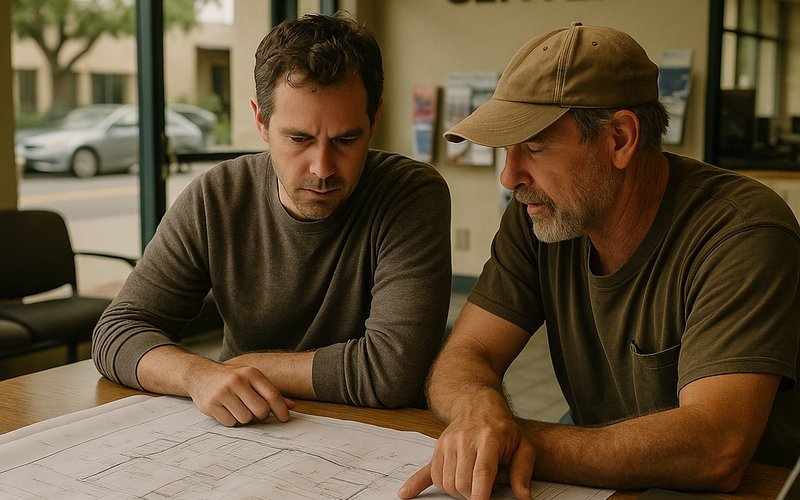
The City of Palo Alto Development Services Center reviews both project types, but ADUs follow a streamlined ministerial approval process under state law, while room additions go through standard discretionary building permit review that checks FAR, setbacks, and design consistency.
For a room addition, you’ll need a building permit application, structural plans stamped by a licensed engineer if you’re adding a second story or altering load-bearing walls, and Title 24 energy compliance documents. Review typically takes 6–10 weeks depending on plan check backlog and whether your addition triggers a planning review for FAR or height.
ADUs move faster on paper. Under state law, Palo Alto’s Development Center (Planning & Development Services) must approve or deny a complete ADU application within 60 days. In practice, most straightforward detached ADU applications in Palo Alto clear plan check in 8–12 weeks, since utility connections, fire separation requirements, and Title 24 compliance for a full dwelling unit add review complexity that a simple room addition doesn’t have.
- Submit a complete application with site plan, floor plan, and elevations
- Pass zoning review for setbacks, height, and FAR (or ADU exemptions)
- Clear structural and Title 24 energy plan check
- Schedule inspections at foundation, framing, and final stages
- Obtain final sign-off and certificate of occupancy (ADUs only)
For a detailed walkthrough of the permit process specific to additions, see our room addition permit requirements guide for Palo Alto.
Room Addition vs. ADU in Palo Alto: The Final Verdict
If you want more livable space for your own family and the most predictable resale return, a room addition wins in most Palo Alto neighborhoods. If you want rental income or long-term housing flexibility and your lot has the depth to support it, an ADU wins.
There’s no universal right answer here, and that’s exactly why so many homeowners get stuck comparing the two. A family in Old Palo Alto with a growing household and a narrow lot has a very different calculation than a homeowner in Green Acres with a deep backyard and an interest in rental income. The room addition vs ADU Palo Alto decision really comes down to your lot’s physical constraints and what you actually want the space to do for you.
Cost alone shouldn’t decide it. An ADU costing $100,000 more than a room addition can still be the better financial move if it generates $4,000 a month in rent. But a room addition costing less can still be the smarter move if your priority is resale value and you don’t want tenant responsibilities.
Next Steps: How to Plan Your Room Addition in Palo Alto
Start by getting a site evaluation that maps your lot’s setback lines, FAR remaining, and foundation condition before you commit to a design. This tells you exactly how much addition space your lot can legally support.
From there, work with a licensed contractor to develop floor plans that match your household’s actual needs, whether that’s a fourth bedroom, an expanded kitchen, or a second full bathroom. King David Home Builders has handled room additions and custom home projects across Palo Alto, and we walk clients through Development Services Center requirements from the first sketch to final inspection.
If a room addition looks like the right fit after reading through this comparison, our complete guide to adding an extra room to your Palo Alto home covers everything from cost per room type to how to sequence your permit application. Reach out for a free, no-pressure estimate, and we’ll help you figure out what your specific lot can realistically support before you spend a dollar on design.