
In San Jose, the rise of Accessory Dwelling Units is not just a design trend, it’s a direct response to structural pressures in the housing market. With limited land availability across Santa Clara County and sustained demand driven by the broader Silicon Valley economy, homeowners are increasingly turning toward ADU construction in San Jose as a practical way to expand housing capacity and unlock property value.
Yet behind the surge in backyard units and garage conversions lies a more complex reality. Building an ADU in San Jose is not constrained by a single factor, but rather shaped by the intersection of regulatory precision, labor market limitations, and cost escalation in one of the most competitive construction environments in the United States.
Regulation in San Jose: Streamlined on Paper, Complex in Practice
California’s statewide push to encourage ADU development has simplified many baseline requirements—reduced parking mandates, relaxed owner-occupancy rules, and faster approval timelines. However, within San Jose, these policies are layered with local planning standards that demand careful interpretation rather than simple compliance.
Setbacks, lot coverage ratios, and height limitations may appear straightforward in municipal documents, but their application often varies depending on lot configuration, existing structures, and utility access. For example, a detached backyard ADU that meets state size allowances may still require design revisions due to fire access requirements or utility easements specific to a neighborhood.
For homeowners pursuing ADU construction in San Jose California, this creates a critical inflection point early in the process: projects succeed or stall based on how accurately these constraints are understood during the design phase. Misalignment doesn’t just delay approval—it can force structural redesigns that materially impact cost and feasibility.
Labor Shortages: The Hidden Constraint Behind Every Timeline
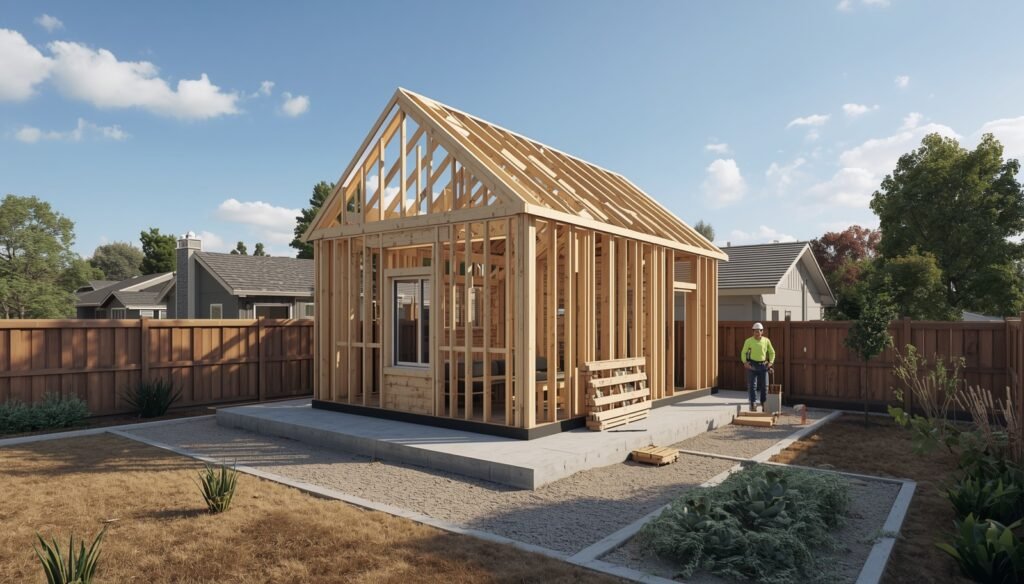
While regulatory complexity is visible, labor scarcity operates more subtly—and often more disruptively.
The demand for residential construction in San Jose has remained consistently high, fueled not only by ADUs but also by full-scale remodels, tech-driven relocations, and multi-generational housing needs. The supply of skilled trades, however, has not scaled at the same pace.
Electricians, plumbers, framers, and finish carpenters are frequently booked months in advance. As a result, even well-planned backyard ADU construction in San Jose projects encounter staggered timelines, where progress pauses between phases—not due to design or permitting issues, but simply because the next trade is unavailable.
This dynamic has two direct implications:
- Project durations often extend beyond initial estimates, sometimes by several months
- Labor costs increase as contractors compete for limited skilled crews
In practical terms, the timeline of an ADU project in San Jose is no longer dictated solely by construction complexity it is equally shaped by workforce availability.
Cost Pressures: More Than Just Price Per Square Foot
Discussions around cost to build an ADU in San Jose CA often center on per-square-foot estimates, but this metric alone does not capture the full financial picture.
San Jose’s construction environment introduces layered cost variables:
- Site-specific preparation, particularly on sloped or constrained lots
- Upgrades to aging utility infrastructure, including electrical panels and sewer connections
- Permit fees and city-related costs that vary by project scope
- Design adjustments required to meet local planning interpretations
In many cases, these indirect costs are what differentiate a controlled project from one that exceeds budget expectations. This is particularly relevant for homeowners entering the process with generalized assumptions based on statewide averages rather than local realities.
Demand Pressure: Why Everything Is More Competitive in San Jose
The intensity of the market in San Jose amplifies every stage of the ADU process.
Contractors with proven experience in design-build ADU contractors San Jose projects are in high demand. This creates a selection environment where availability becomes as important as qualification. Homeowners often face longer lead times just to begin design consultations, particularly with firms that specialize in navigating San Jose’s permitting landscape.
This demand also influences pricing stability. In less competitive regions, homeowners may negotiate construction costs or timelines. In San Jose, where project pipelines remain full, pricing tends to be more fixed, and scheduling flexibility is limited.
Strategic Decision-Making: What Actually Improves Outcomes
The complexity of ADU regulations in San Jose California and labor constraints does not eliminate opportunity—but it does require a more strategic approach.
Projects that perform well, both financially and functionally, tend to share several characteristics:
They are planned with regulatory alignment from the outset, rather than adjusted later.
They prioritize design efficiency over unnecessary size, particularly in the 500–800 sq. ft. range where construction and rental economics balance effectively.
They are executed by teams with direct experience in San Jose’s approval process, not just general construction backgrounds.
Garage conversions, for example, often present fewer regulatory barriers and reduced construction timelines, making them a practical entry point for homeowners evaluating garage conversion ADU San Jose cost versus ground-up builds.
At the same time, detached ADUs, while more complex, offer stronger long-term flexibility—particularly for rental income or multi-generational use.
A Market Defined by Constraints—and Opportunity
What makes ADU construction in San Jose unique is not just the opportunity it presents, but the level of precision required to realize it.
This is not a market where generic construction strategies perform well. Each decision—from site planning to contractor selection—has measurable implications on timeline, cost, and long-term value.
For homeowners, the key shift is perspective. ADUs are no longer secondary structures; they are micro real estate investments embedded within primary residences. As such, they demand the same level of due diligence, market awareness, and execution discipline as any income-generating property.
Closing Insight
San Jose’s ADU landscape reflects a broader truth about high-demand housing markets: the greatest opportunities exist where complexity is highest.
Navigating ADU construction in San Jose California requires more than intent—it requires alignment between design, regulation, labor, and cost strategy. When those elements come together effectively, the result is not just additional space, but a durable increase in property performance.
Frequently Asked Questions: ADU Construction in San Jose
1. What are the biggest challenges in ADU construction in San Jose?
The primary challenges include navigating city-specific ADU regulations, securing permits without delays, and managing labor shortages that extend construction timelines. Unlike smaller markets, San Jose requires precise compliance with zoning, setbacks, and utility requirements, which can significantly impact project feasibility if not addressed early.
2. How long does ADU construction take in San Jose, considering labor shortages?
A typical ADU project in San Jose takes between 8 to 14 months, including design, permitting, and construction. However, labor shortages—especially among electricians, plumbers, and framers—can extend timelines further, particularly during peak construction periods.
3. What is the average cost of ADU construction in San Jose California?
The cost to build an ADU in San Jose generally ranges from $250 to $450 per square foot, depending on design complexity, site conditions, and material quality. Additional costs such as utility upgrades, permits, and site preparation can significantly influence the final budget.
4. Are San Jose ADU regulations different from California state laws?
Yes. While California provides a framework that encourages ADU development, San Jose enforces local zoning standards, including height limits, lot coverage, and specific setback requirements. These local rules often determine whether a project is approved or requires redesign.
5. Is building an ADU in San Jose still worth it despite high costs and delays?
In most cases, yes. Strong rental demand in Santa Clara County allows ADUs to generate consistent income, while also increasing overall property value. Even with higher upfront costs, many homeowners see long-term returns through rental yield and appreciation.
6. How do labor shortages impact ADU construction in San Jose?
Labor shortages can lead to project delays, increased labor costs, and scheduling gaps between construction phases. Skilled trades are often booked months in advance, making contractor availability a critical factor in project planning.